
Oh. THE question. The student question to end all student questions. Every time it is asked, the students think they got me. They believe they have posed an existential question that will cause me to spontaneously combust and they can all just step over my ashes and go home. In their defense, I have seen teachers lose their mind over the question before. It is frequently met with condescension, eye rolls, or just outright ignored by staff. However, this question can derail a single class period, and if answered in an unsatisfactory way (or ignored long enough), teachers risk losing the respect and buy-in of their students. Unlike when you asked your mom why you had to do the dishes, “because I said so” won’t work.
“When will we ever need this in real life?” Okay. I’ll bite.
Like it or not, fellow teachers, it is a fair question. Yeah, it is annoying to spend time answering it. However, it *is* important that students know why they are doing what they’re doing. Lessons (and classes) that they believe apply to their life have increased levels of engagement. Students work harder for those teachers and behave better in those classes. Increased engagement means that more respect is present, and more learning is taking place.
I can only answer this question as it pertains to my class, but perhaps what I tell students will help people to understand why this question isn’t really brought up in my class more than once. There is a distinct reason why, and I hope that it gives you a perspective on what the modern public school classroom looks like (at least for me).
I recently did an activity with my students. In this lesson, they were asked to “Make a recommendation to the school board” on which class offerings they would keep, and which ones they would eliminate. They had to eliminate three of the items you see below. Given the vast budget cuts that have taken place in my district over the past 15 years, this hit them close to home. All of these kids have seen classes and teachers eliminated in their time in our district. The students sat up and locked in. To have power over what classes stay and which ones go? Intriguing. They were given time alone to complete the page you see below, and then time to deliberate with peers before making their final recommendation.
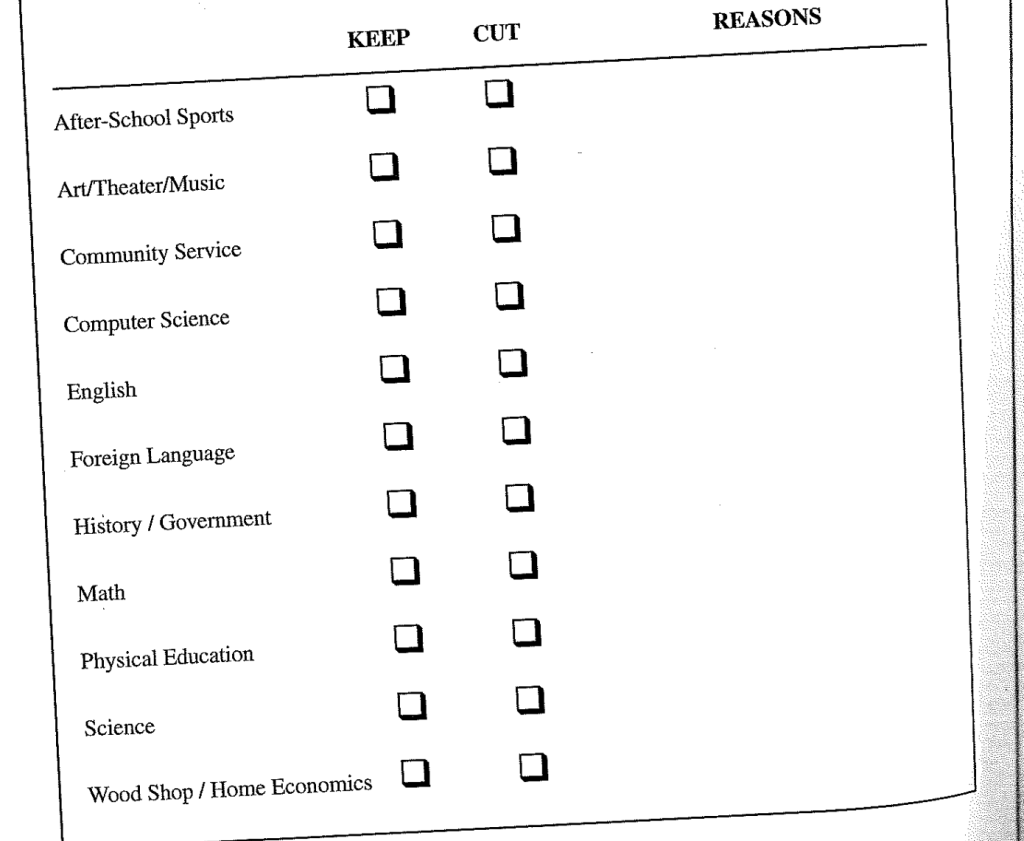
Of course there were some “math sucks so I’m getting rid of math” votes. But by and large? The students took it seriously. They carefully considered what was most important to their future and had conversations about what they believe matters in education. That is productive and mature discussion, and being moderated by a teacher meant they did better than your average social media commenter.
These kids are 12.
They didn’t even realize it, but they just spent a class period having a conversation about their values, and why school is important.
For the record, the most commonly axed subjects were, in order – Computer Science, Foreign Languages, and History/Community Service tied for third. They explained to me that History was an offshoot of ELA and therefore was being addressed. I disagree but didn’t say as much. They’re allowed to have dumb ideas sometimes and the lesson doesn’t need a Devil’s Advocate.
This activity was paired with my lesson on the Ancient Spartans, which asked “Did the strengths of Spartan education outweigh the weaknesses?”, originally created by the DBQ Project over a decade ago. By doing this, I am having the students analyze their values and the values of the society we live in. We compare our values to the values of ancient peoples. Obviously, we have left the Spartan way behind. Students are left to decide why that is and if it was for the best or not.
Given the priming activity we just did, they had important practice on the kind of critical thinking required to give a thoughtful answer to that question. Students then write their answer out in an extended response, and I use that for their grade. This also gives me a chance to evaluate their writing ability and help them to improve. Sometimes they give surface level answers, and sometimes they give answers that show the critical thinking I am looking for. Either way, very few students miss the point of the lesson.
By being asked to both understand history and their own values, students are giving a higher level response than they would be otherwise. Furthermore, they are excited to learn about these things. They are given chances to share their thoughts and opinions with peers. That matters because it teaches them to listen/learn from others and also forces them to have clarity in how they express their opinions. That clarity often translates to better written responses, as well.
Then it was asked. “Mr. Callison, when will we ever need this in real life?”
At least two of my six classes brought it up. But when they asked, I was ready. So were they. My students had the answer ready for me. They said that while not always exciting, it was important to their lives. They gave examples from the lesson. Yes, it is unlikely they will ever need to know facts about the ancient Sparta in their day to day life. But they will be required to know and use their values, and that’s what they were really talking about. Only a daily basis, they will need their value system as they seek to build relationships in their personal and professional lives. I know it. Now they know it, too.
We do these kinds of lessons frequently. They are an inherent rebuttal to “I’m never going to use this in real life!” people. In my class, we talk about personality types, corporal punishment, & ethical dilemmas. We talk about historical events and peoples, and students construct meaning by analyzing and discussing together. Yeah, it is unlikely that they will ever need to know various historical facts in their day to day life. No one will care if they remember what the name of the Spartan school system was (the agoge) or if they know when Alexander the Great died (323 BCE). But they will need to know how to listen to, and work with, others. They will need to know how to read, and comprehend what they read, especially things they don’t know about. They will need to be able to write clearly and concisely. They should learn how to analyze evidence and use it to make or support arguments. Most importantly, students need to learn how to think critically, about themselves, events, and their values. We learn these things in my class.
I want them to give their opinions and think these things through. At times it will be messy and immature, but that’s teenagers, baby. They need to start somewhere. Might as well be right here and right now.
The world at large demands more than tacit compliance from our productive citizens, and it is a grievous disservice to students to pretend that the world will (or should) bend to their particular set of values.
In this manner, I am proud to teach in a public school that gives me the freedom to do these lessons with my students. I am proud to teach students who come to me with all their baggage, biases, excitement, boredom, and everything in between. I am happy to teach the rich and the poor, and am grateful that I have a wide variety of socioeconomic classes to mix together. I am happy to answer why I think my class matters. I am confident in my teaching, and my students are satisfied with my answer. As per usual, the lessons in life that really stick come from the little lights that come on within each student.
“When will we ever need this in real life?” The students experience why my class matters every day. So go ahead, ask. They don’t need to ask twice.
 Teaching on the Run
Leave a comment