
Training update – it is hot.
I experienced true heat exhaustion for the first time in my life on a recent trail run. I was nauseous, vomited, and was completely out of it. I couldn’t remember all my steps in my cool down. I caught myself wandering around in the grass and failed to walk a straight line. I got mentally side tracked multiple times and kept forgetting where I stashed my keys. It took nearly 30 minutes of just sitting in my car to come back to my senses. The coach in me was admonishing myself for being foolish enough to run in the afternoon during a heat advisory, but it had never happened before and my stubbornness triumphed over wisdom. As I was ringing out the sweat from my socks, I knew it was time to reconsider my priorities and do some experimenting. So… let’s talk about what exercising in the heat does to you.
In June and July (thus far), most of the Eastern and Northern US has experienced a nasty heat wave. Several regions have hit all time highs, and New York City was just reclassified as a sub-tropical climate. In Ohio, daily temperatures have been in the high 80’s Fahrenheit and humidity in excess of 70% each day. We have another week of heat advisories ahead. Being outside is miserable. The pavement is hot enough to fry eggs and the humidity makes the air feel like a bowl of soup. But I have to train, and as always I train whenever I have time, not necessarily when the weather is ideal. This presents an inherent problem because running in this weather feels like an exercise in self-loathing.
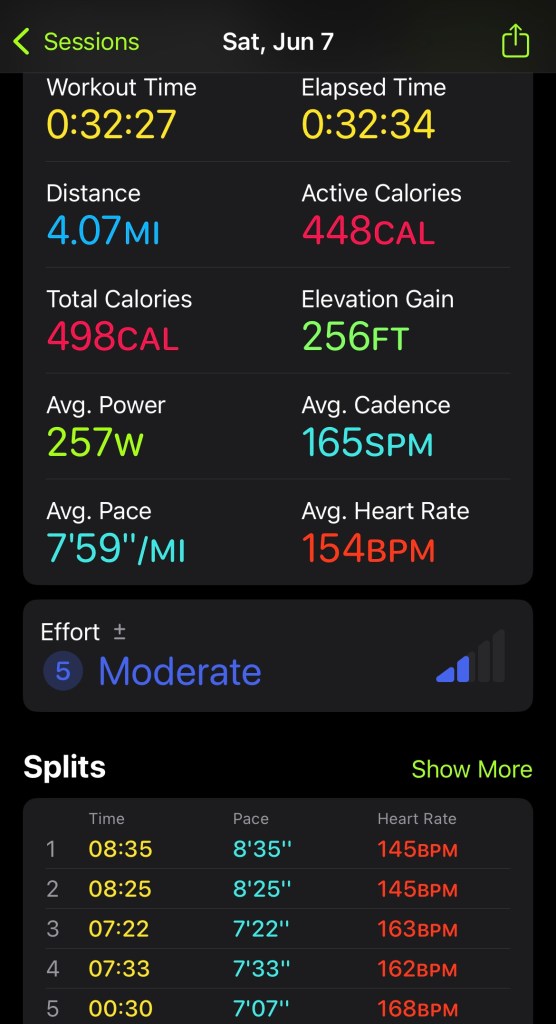
I did an experiment with two of my workouts to illustrate my point. One in cool weather and one in blistering heat. I ran both of these runs as close to 8:00 miles as I could manage. They had similar elevation and were run on pavement. The first run was in mild conditions. It was run in Southport, Maine on 6/7. It was 58 Fahrenheit with around 98% humidity (it was misting). In the first run, you can see that my effort and heart rate stayed steady. I felt good enough to up-pace in the last two and it felt pretty easy the whole time. My heart rate came down to resting within five minutes. My Apple Watch rated my effort as “Moderate”.
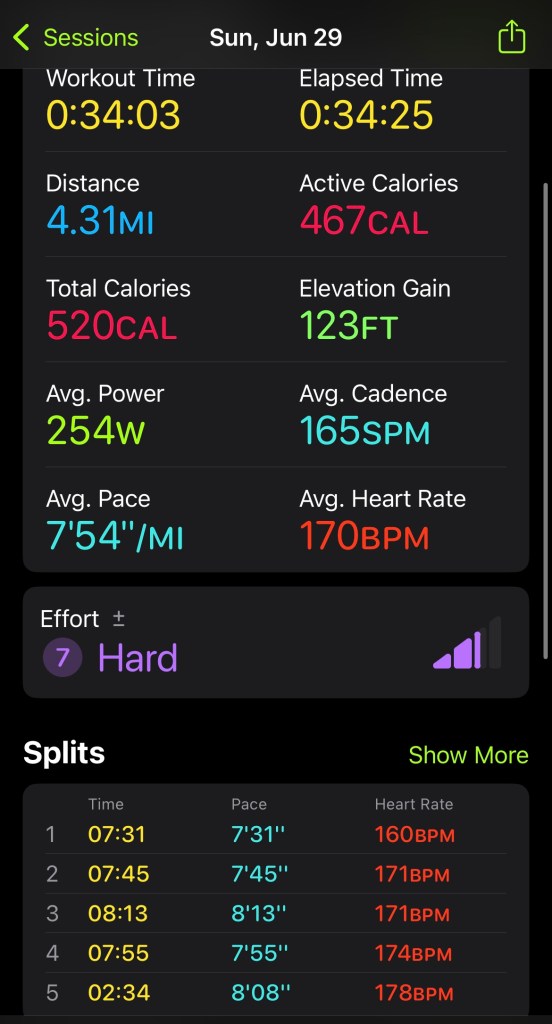
My second run was done in scorching heat in Ohio on 6/29 with the heat being 84 Fahrenheit and with 75% humidity. In the second run, you can tell the difference almost instantly from the splits. My heart rate shot up instantly. I hit 170 right after the first mile, which is usually my HR during race-level efforts. I tried slowing down in the final two miles to bring it back to normal, just to see if I could. I couldn’t. My HR skyrocketed and stayed there. I felt light-headed and foggy as I went to finish the run. I didn’t get back to my resting heart rate for nearly 15 minutes, and required me going inside after 5 minutes standing in the shade wasn’t working to bring it down. It was horrid.
This illustrates a couple of things. Note how humidity alone isn’t a huge problem. In Maine the humidity was nearly 100%, but my heart rate stayed low because the temperature was also low. My body was thermoregulating fine because the low temps offset the spike in body temperature that occurs with exercise. In essence – the humidity was okay because it was cool out. Add in the heat and that’s when the problems start. In the second run I started sweatily quickly because of the heat, and the humidity meant that sweat didn’t evaporate to cool my body. It sat on my skin and accumulated, making me feel hotter and making my heart rate spike. My run in the heat felt worse, took longer to recover from, and was significantly harder on my body. I could feel it, and my heart rate backed that feeling up with hard data.

The lessons from this are twofold. One has to do with understanding your body’s limits, and the other is about how to adapt to the summertime.
Heart rate (HR) is one of the most important health metrics you have. It’s easy to monitor with a watch or other device, and knowing it is vital to understanding your overall health and fitness. HR can also be improved. It improves (is lower) the more cardio fitness you acquire. A low heart resting heart rate is something doctors look for because it indicates better cardiovascular health, thereby lowering your risk of blood pressure and cholesterol related heart problems. Running results in lower resting heart rates and greater cardiovascular health. And it has the added benefit of outliving your enemies, which is something I aspire to daily.
In my opinion, tracking your HR is essential to running. A low heart rate while running is fundamentally less demanding on your body. I have always liked cars for an analogy of this. There’s a reason those geriatric Sunday drivers are still chugging away in their 2001 4-door sedans on the way to church. They drive slowly, change their oil/tires/fluids/brakes with annoying frequency, and generally practice responsible car ownership. It’s annoying to everyone piled up behind them, but ultimately their cars will last longer and experience less issues…Then you have the aggressive driver. This person treats every light that turns like a drag race, thinks oil changes are more like guidelines than rules, and generally drives like John Candy. In cars driven by those people, systems will break quickly and severely.

Running is just like those two drivers. If you’re doing all of your workouts with your heart rate near your max, you are going to be exhausted all the time and at an exponentially higher risk of injury. Add some heat and now you also have the risk of heat exhaustion and heat stroke. And the worst part? It doesn’t make that big of a difference! One to two hard workouts a week. That’s all you need. And that’s only if you’re trying to be competitive in races! Don’t believe me? Check the data. Or check the most popular workout plan followed by marathoners and cyclists.

Your workouts at a high HR are only making you marginally better than someone who took it easy. So use them sparingly and intentionally. People who can maintain a lower heart rate while exercising can walk, run, row, and bike further and they recover faster. Focus on duration, not intensity. This goes for all ages.
So we know the heat makes it harder to get in quality workouts. The humidity makes it even harder. You shouldn’t stop exercising outside just because of poor weather, though. And if last year was an indication? This heat will be a daily problem until late October. Time to adapt. So what can you do about it?
- Hydrate. You don’t need to be chugging a gallon of water (yay bathrooms!) and you don’t need to be forcing down salty electrolytes all day long. Just…Be intentional. Drink a glass when you get up. Drink one with meals. Know when you’re working out and hydrate leading up to that time. Start drinking sparkling water if you get bored of the plain taste. Avoid diuretics like coffee and energy drinks (post-exercise treat, anyone?). Just don’t go into these weather conditions without fluids in your system, or you’re going to suffer greatly and it will be your own fault.
- The gym is your friend. Feel that crisp A/C? Smell the Fritos body odor? See the treadmill and the elliptical and the stair-stepper? That’s your best bet. I hate indoor cardio machines as much as the next sane person, but throw on a YouTube channel you like and gut it out. I can recommend some excellent WWII focused channels if you want?
- Beat the sun. This seems obvious but it matters. The heat and humidity are 15-20% lower in the morning. That’s significant. Get out there and get it done before the sun is up or as it is setting for the day. If you’re a parent or a 1st shifter like me, though, this is understandably difficult. But those 4:30 workouts will make your day better every single time. I’ve almost never done one and had a bad day afterwards. Exercise is a cheat code to improve your mood.
- Walking is fine. Walking is great, actually. I would much rather see someone walk than see someone suffer heat exhaustion. Incline walking is incredibly good for calorie burn and is awesome for joints. Push harder when the conditions are better. If you’re a beginner I like the 1 minute to 1 minute run-walk ratio. For more experienced runners I like the run 7 minutes and walk 3 minutes ratio.
I’ll close with this – I hate summer. Always have and always will. My students tell me I’m alone in this, so I’m hoping you will do the poll below and prove that I’m not the only one.
 Teaching on the Run
Leave a comment